Last Edited:
The whirlwind of on-demand companies has disrupted this decade’s tech boom, redefining patience as an overrated virtue.
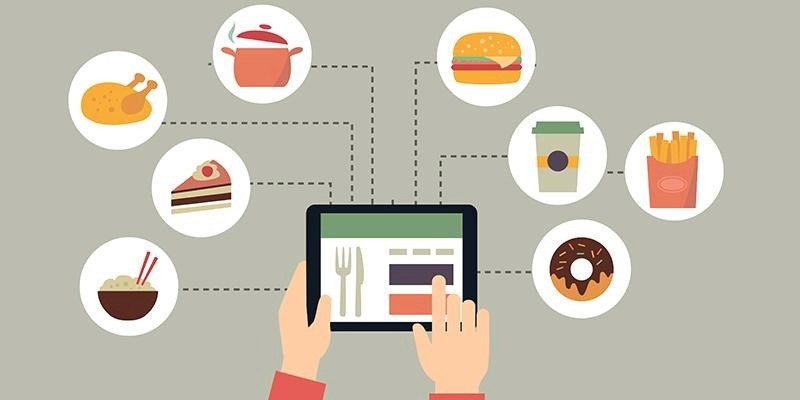
Figure 1. Source: https://www.linkedin.com/pulse/why-necessary-develop-food-ordering-app-app-on-lease
The on-demand economy is seen by many as the future of “everything” (Fowler, 2015). With the iterative breakthroughs of evolution in mobile technologies and connectivity, there has been an explosion of businesses rushing to grab a piece of this enormous pie.
According to Mike Jaconi (2014), the on-demand economy is described as the economic activity developed by technology companies meant to meet the demands of their users through the instantaneous supply of goods and services. However, this concept is not new - online grocery firm Webvan and urban delivery company Kozmo were two high-profile flop companies in the late-1990s dot-com boom (Fortune, 2016).
The demands and behaviours of consumers are changing as the convenience of smartphones has propelled a sense of entitlement to swift and effortless experiences at the tap of a finger. In the words of Twitter founder Ev Williams (Tate, 2013), “If you study what the really big things on the internet are, you realise they are masters at making things fast and not making people think.”
Even though most of the on-demand businesses are less than 8 years old, more than 22.4 million consumers in the United States spend $57.6 billion annually in the on-demand economy. (Coby and Bell, 2016) In addition, the implementation of such a service reduces a company’s operational cost and boosts efficiency whilst keeping the customer satisfied - it is no wonder that there is a growth of companies competing in this space. The resulting spurt in funds from institutional investors suggests that the on-demand economy is going to be a force for years to come.
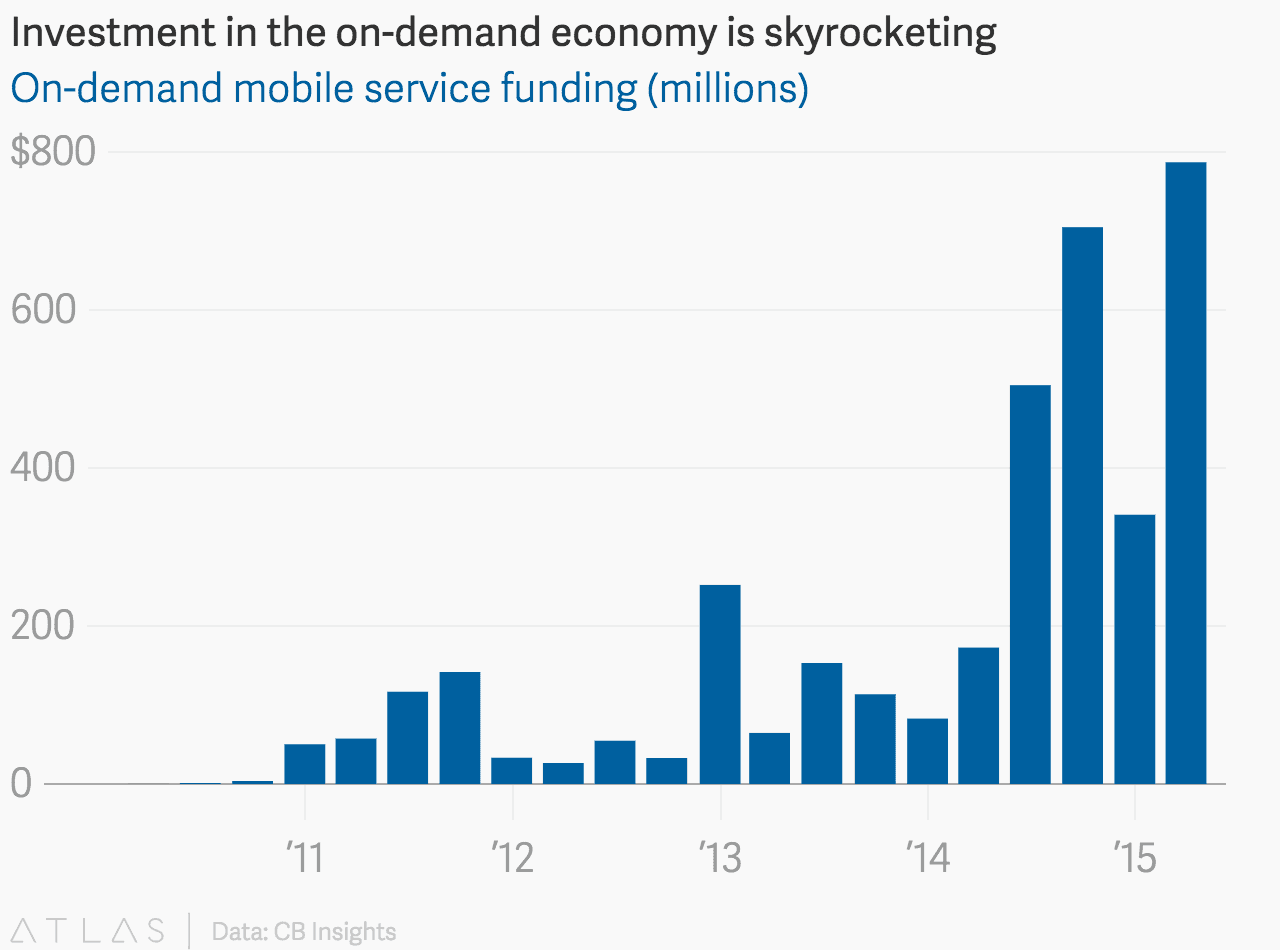
Figure 2. Source: The Atlas, 2016
The food and beverage industry is seemingly one to adapt to this shift in trend due to the inevitable association with changes in consumer preferences that are influenced by the varying lifestyles and resources available to them. For example, most people only have an average of 34 minutes for their lunch break (Christie, 2017). Therefore, as lunch breaks get shorter, so do people’s tolerance levels. Consumers are demanding independence and convenience without wasting their time waiting in a queue, which explains why over 62% of Millennials have become mobile ordering converts (PYMENTS.com, 2017).
A study by Deloitte (2013) was conducted to identify the main challenges faced by businesses that are trying to deliver the digital experience their customers want. The research highlighted that “the real importance of digital to business is not the emergence of new technology; the importance is the shift in customer behaviour”. Therefore, it is no longer a question of the revolutionaries in the on-demand economy, as it is all currently happening. Many businesses see past that, and along with being in a highly saturated market, a lot of on-demand companies have faced demise.
An example would be Dazo, a food delivery service in India that caters to the busy and hungry. The company offered a limited menu of items, prepared in their own kitchens, and delivered within 30 minutes. But despite funding from investors like Amit Agarwal of Amazon India and Rajan Anandan of Google India, they failed to create a product differentiation and ultimately folded within a year. (Chakraborty, 2015)
As the tales of woes pile up, how should businesses innovate and distinguish themselves as winners to compete in an on-demand world?
Brands are Services, and Technology is the Facilitator
The success of brands such as Uber and Facebook is due to their core focus on solving the consumer problem as a service before reframing their technology to assist with it. In a time where change is constant, business strategies should not only be influenced by the marketplace, but also by the exterior factors.
The Importance of User Experience
In this digital age, consumers have more control than ever. The average online consumer makes an average of 9.5 interactions with the brand before purchasing (Digitalstrategyconsulting.com, 2014). This means that the barrier to entry is elevated in order for a brand’s digital story to amass an outcome they fancy, and therefore it is essential to have a UX strategy and design that is customer-centric, whilst also regarding the objectives and desired outcome of the business.
Brand Loyalty
With the feast of options available in the market, another primary focus of a business should be assisting its suppliers and consumers to find all the right reasons to stay with their service for a long time.
A Touch of Personalisation
The customers of today’s world do not need to be told what it is that they want - they already know. Businesses should acknowledge these customers through their offerings, instead of tossing them with the options they did not ask for.
Embrace Collaborations
The competition in the on-demand economy is fierce. Businesses should be smart to break down the traditional organisational silos by working jointly with other companies to survive instead of fighting for similar suppliers and customers. A prime example would be Uber - they have integrated their logistics networks with other on-demand companies for a fee (UberRUSH, n.d.).
Increase Brand Awareness
Growth can spurt from anywhere, at any time, in the world of the on-demand economy. This means that the presence of brands is essential; therefore, businesses should work on ringing a bell in people’s heads by pushing their brand name out there as soon as possible.
Tapping into Application Program Interface
According to Brian Proffitt (2013), an Application Program Interface (API) is “a set of requirements that govern how one application can talk to another.” On the web, APIs are what enable services like Google Maps and Facebook to allow other applications to ride on their offerings. That being said, APIs can help businesses tap into providing their services to others, establish a new business and welcome an extra source of revenue stream, and promote brand visibility and growth opportunities.
Conclusion
The business landscape is a perpetual change. Companies should not oppose change, but acknowledge it as a different form for improvement, learning, and connection with new customers by embracing it instead. With the world of the on-demand economy showing no indication of slowing down, the businesses that will stand out will be those that continually evolve into the future.
References:
Chakraborty, S. (2015). Food tech start-up Dazo shuts down. [online] http://www.livemint.com/. Available at: http://www.livemint.com/Companies/PktFeP7GxNdXHg5VixV8WP/Food-tech-startup-Dazo-shuts-down.html [Accessed 2 Nov. 2017].
Christie, S. (2017). Average British worker takes just 34 minutes for their lunch break. [online] The Telegraph. Available at: http://www.telegraph.co.uk/business/2017/07/19/average-british-worker-takes-just-34-minutes-lunch-break/ [Accessed 3 Nov. 2017].
Coby, C. and Bell, K. (2016). The On-Demand Economy Is Growing, and Not Just for the Young and Wealthy. [online] Harvard Business Review. Available at: https://hbr.org/2016/04/the-on-demand-economy-is-growing-and-not-just-for-the-young-and-wealthy [Accessed 3 Nov. 2017].
Deloitte (2013). The digital transformation of customer services. [online] Netherlands. Available at: https://www2.deloitte.com/content/dam/Deloitte/nl/Documents/consumer-business/deloitte-nl-the-digital-transformation-of-customer-services.pdf [Accessed 2 Nov. 2017].
Digitalstrategyconsulting.com. (2014). Savvy shoppers make 9 visits to a retailer’s site before deciding to buy. [online] Available at: http://www.digitalstrategyconsulting.com/intelligence/2014/11/savvy_shoppers_make_9_visits_to_a_retailers_site_before_deciding_to_buy.php [Accessed 3 Nov. 2017].
Fortune. (2016). Why Silicon Valley VCs Are Giving Up on On-Demand Delivery. [online] Available at: http://fortune.com/2016/12/13/vc-ondemand-delivery-investment/ [Accessed 4 Nov. 2017].
Fowler, G. (2015). There’s an Uber for Everything Now. [online] The Wall Street Journal. Available at: https://www.wsj.com/articles/theres-an-uber-for-everything-now-1430845789 [Accessed 4 Nov. 2017].
Jaconi, M. (2014). The 'On-Demand Economy' Is Revolutionizing Consumer Behavior — Here's How. [online] Business Insider. Available at: http://www.businessinsider.com/the-on-demand-economy-2014-7?IR=T [Accessed 1 Nov. 2017].
Proffitt, B. (2013). What APIs Are And Why They're Important - ReadWrite. [online] ReadWrite. Available at: https://readwrite.com/2013/09/19/api-defined/ [Accessed 4 Nov. 2017].
PYMNTS.com. (2017). Mobile Ordering, The New Window To Winning Over Millennial Consumers. [online] Available at: https://www.pymnts.com/mobile-order-ahead/2017/mobile-order-ahead-millennials/ [Accessed 2 Nov. 2017].
Tate, R. (2013). Twitter Founder Reveals Secret Formula for Getting Rich Online. [online] WIRED. Available at: https://www.wired.com/2013/09/ev-williams-xoxo/ [Accessed 4 Nov. 2017].
The Atlas. (2016). Investment in the on-demand economy is skyrocketing. [online] Available at: https://www.theatlas.com/charts/41EiJLUzg [Accessed 1 Nov. 2017].
UberRUSH. (n.d.). UberRUSH. [online] Available at: https://rush.uber.com/how-it-works [Accessed 1 Nov. 2017].
This article was written for the University of Sydney's Master of Management Business Project assignment.